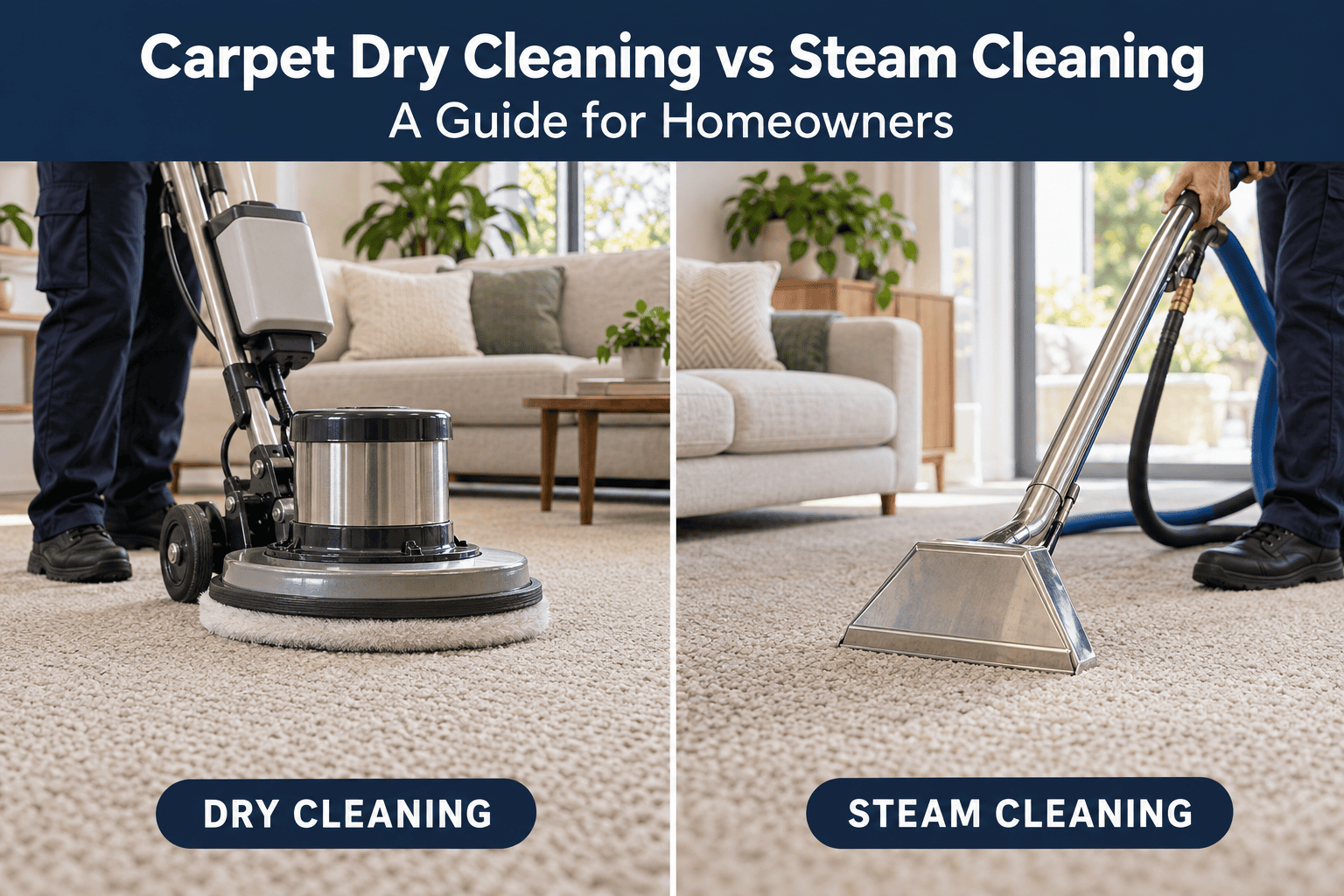
Carpets handle plenty of everyday wear in an Australian home. There are sandy shoes near the entrance, food spills around the dining table and familiar walking tracks between the sofa and kitchen. When vacuuming no longer improves their appearance, choosing the right professional cleaning method becomes the next step.
If you are comparing Carpet Cleaning Perth services, you will probably see both dry cleaning and steam cleaning advertised. Each has a useful place in carpet care, but the right choice depends on your carpet’s material, how dirty it is and how soon you need to use the room again.
This guide explains the differences, the practical limitations and the questions worth asking before booking.
What Is Carpet Dry Cleaning?
Carpet dry cleaning is a broad term for methods that use relatively little moisture. Despite the name, it does not always mean that no water is involved.
Depending on the system, a cleaner may use an absorbent compound, a low-moisture cleaning solution or a pad that collects loosened soil. Ask which process the company uses, because services advertised as “dry cleaning” can work differently.
One common example is bonnet cleaning. After vacuuming, the cleaner uses a cleaning product and an absorbent pad to transfer soil from the carpet onto the pad.
Low-moisture cleaning can be useful for maintaining appearance when a room needs to return to use quickly. However, surface-focused methods may not provide the same corrective clean as hot water extraction for heavily soiled carpet.
When Dry Cleaning May Be Suitable
Consider discussing a low-moisture method when:
- Your carpet needs a maintenance clean between deeper cleans.
- Soiling is relatively light.
- You have limited time to keep a room out of use.
- The process is permitted by your carpet manufacturer.
A shorter drying period is useful, but suitability should come first. A method that works well on one carpet may be inappropriate for another.
What Is Carpet Steam Cleaning?
Professional carpet steam cleaning usually refers to hot water extraction. The machine applies water and cleaning solution, then extracts the liquid along with loosened soil.
The process commonly includes vacuuming, pretreatment and attention to individual spots before extraction. It is different from passing a household steam mop over the carpet.
The Carpet Institute of Australia identifies hot water extraction as a widely used method for both interim cleaning and deeper corrective cleaning. It also advises choosing a process according to the manufacturer’s care and warranty documentation.
When Steam Cleaning May Be Suitable
Discuss hot water extraction with your cleaner when:
- Walking routes look noticeably darker than surrounding areas.
- General soiling remains after thorough vacuuming.
- The carpet needs a more substantial clean.
- You can allow time for drying.
- The manufacturer recommends or permits the method.
Tell the cleaner about previous treatments, recurring marks and any areas that have become wet. This helps them assess the job before starting.
Carpet Dry Cleaning vs Steam Cleaning: Comparison Table
| Factor | Dry or low-moisture cleaning | Steam cleaning or hot water extraction |
| Main approach | Uses a compound, solution or absorbent pad, depending on the system | Applies water and cleaning solution, then extracts the liquid |
| Moisture level | Generally lower | Generally higher |
| Typical role | Maintenance and appearance improvement | Interim or deeper corrective cleaning |
| Drying | Usually quicker, depending on the process | Requires a drying period |
| Heavy soiling | Results depend on the system and condition | Often considered where more substantial cleaning is needed |
| Main question to ask | “Which low-moisture process do you use?” | “How will you control moisture and support drying?” |
| Suitability | Check the carpet’s care instructions | Check the carpet’s care instructions |
For business premises, choosing between dry cleaning and steam cleaning also depends on foot traffic and operating hours. When booking Commercial Carpet Cleaning Perth, discuss your carpet’s condition and available drying time with the cleaner to find a suitable approach with minimal disruption.
Which Method Is Better for Your Home?
Start with the problem you want to solve.
A lightly soiled spare bedroom may need a different approach from a family lounge that has handled years of foot traffic. Similarly, a quick refresh before guests arrive has different scheduling needs from cleaning an empty home before moving in.
Describe the carpet’s condition when requesting a quote. Useful details include:
- Which rooms need cleaning.
- Whether the carpet is wool, synthetic or an unknown material.
- Where stains and darker walking tracks appear.
- Whether pets have had accidents.
- When the carpet was last professionally cleaned.
- How soon the rooms need to be available.
Ask the cleaner to explain why their proposed method suits those conditions. A clear recommendation should connect the process to your carpet and the outcome you need.
How Long Will the Carpet Take to Dry?
Drying time should be discussed before the appointment.
Low-moisture methods generally allow quicker room use. Hot water extraction introduces more moisture, so ventilation and effective water recovery matter. CHOICE gives six to eight hours with proper ventilation as a general guide for extraction cleaning, although conditions vary.
Avoid treating any advertised drying time as a guarantee for every home. Ask for an estimate that considers your rooms, the weather and the proposed process.
For Australian households, seasonal conditions deserve attention. A cool, damp day presents different drying conditions from a warm day with good airflow.
Before the cleaner leaves, confirm when you can walk on the carpet, replace furniture and lay rugs back down.
Will Either Method Remove Every Stain?
A general carpet clean and targeted stain treatment are different parts of the job. Ask whether the quote includes both.
Provide as much information as possible about a mark: what caused it, how long it has been there and which products you have already used. A cleaner can then give a more useful assessment of the likely result.
Avoid judging a service solely by a promise to remove every stain. Ask the technician to distinguish removable soiling from possible permanent discolouration or damage.
For pet accidents, explain whether an odour returns after the surface dries. Request an assessment of the affected area rather than assuming a standard room clean will address the whole problem.
What About Wool Carpets and Unknown Fibres?
Do not select a method purely because it is advertised as gentle or fast.
Check your carpet’s care guide and warranty first. If you have moved into a home and do not know what carpet is installed, ask a technician to identify the fibre and recommend an appropriate process.
The Carpet Institute of Australia specifically recommends expert advice when manufacturer information is unavailable.
Keep any care documents you have and share them before the booking. This is particularly useful when the carpet has specific cleaning restrictions.
Compare the Full Quote, Not Just the Room Price
A low advertised price is difficult to assess without knowing what it covers.
Before booking, ask:
- Is thorough vacuuming included?
- Are spot treatments included or charged separately?
- How are oversized rooms, stairs and hallways priced?
- Which furniture will be moved?
- Are pet odour treatments additional?
- Will drying equipment be needed?
- Does the final quote include GST?
Request a written description of the work. It helps you compare services with different inclusions and avoids confusion on the day.
Preparing Your Home for Carpet Cleaning
A little preparation makes access easier and helps the cleaner understand your priorities.
Remove small items, toys and loose cables from the floor. Point out marks that concern you and mention any fragile furniture near the work area.
Agree on furniture movement in advance. Also plan where children and pets will stay during cleaning and drying, especially if several rooms will be unavailable.
Afterwards, follow the technician’s instructions for ventilation, room use and furniture replacement.
Choosing a Practical Carpet Care Plan
For homeowners, the most useful question is which method suits the carpet’s current condition.
Low-moisture cleaning may be appropriate for maintenance and quicker room use. Hot water extraction may be appropriate when a deeper corrective clean is needed. Manufacturer guidance and an assessment of the carpet should shape that decision.
Between appointments, maintain a routine of vacuuming, entrance-mat cleaning and prompt attention to spills according to the carpet’s care instructions. Professional cleaning works best as part of ongoing care.
